
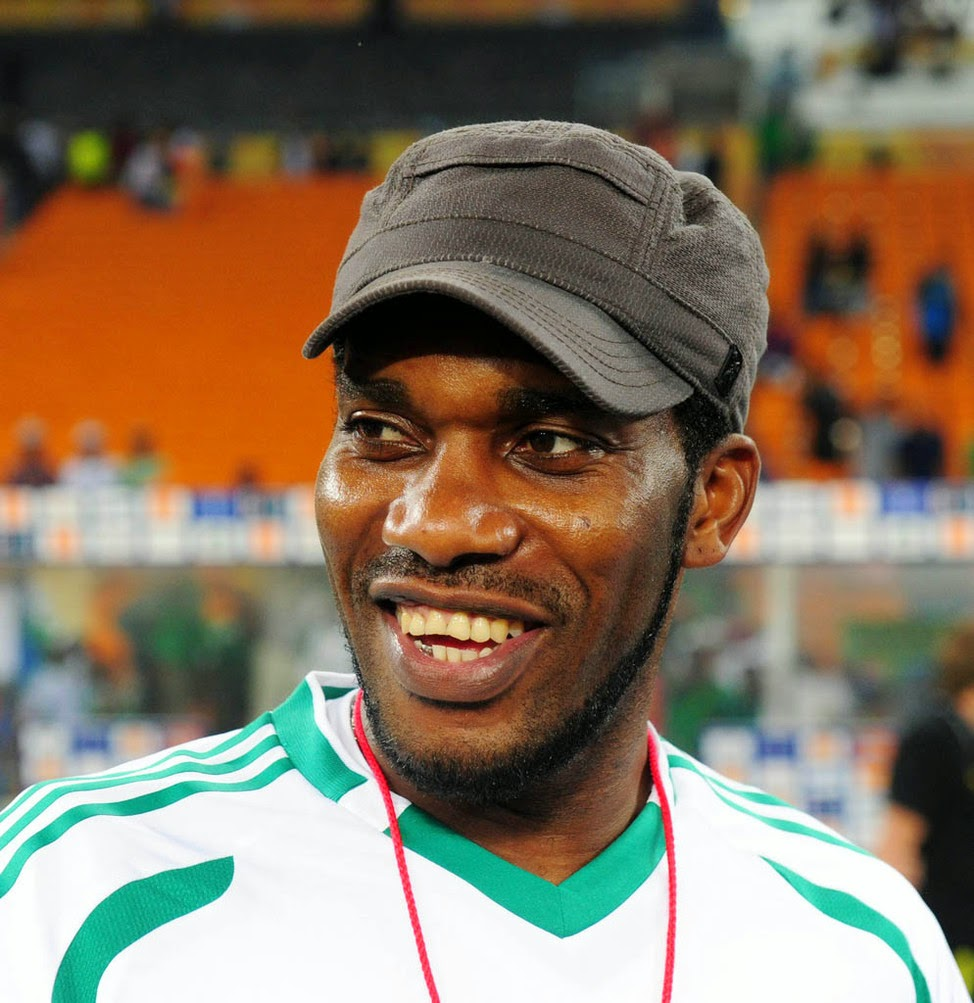

There is a chant that echoes through the corridors of Bolton Wanderers’ football history — “Jay-Jay Okocha, so good they named him twice.” It is a line that perfectly captures the essence of Augustine Azuka Okocha, a footballer whose gifts were so extraordinary that ordinary language struggled to contain them. In a sport full of technically gifted players, Okocha stood apart not just for what he could do with a football, but for the sheer joy he radiated while doing it. He is, by any serious measure, the greatest Nigerian footballer ever produced and one of the most thrilling players Africa has ever offered the world.
Jay Jay Okocha Biography
| Full Name | Augustine Azuka Okocha |
|---|---|
| Nickname | Jay Jay Okocha |
| Date of Birth | August 14, 1973 |
| Age | 52 years old (as of 2026) |
| Nationality | Nigerian |
| Ethnicity | Igbo (Delta State heritage) |
| Height | 5 ft 8 in (175 cm) |
| Religion | Christianity |
| Occupation | Retired Professional Footballer, Football Administrator |
| Net Worth | Estimated $15 million (not publicly confirmed) |
| Spouse | Nkechi Okocha |
| Children | Daniella Okocha, A-Jay Okocha |
Early Life and Background
Augustine Azuka Okocha was born on August 14, 1973, in Enugu State, in the southeastern part of Nigeria. His parents hail from Ogwashi-Uku in Delta State, and the family grew up in Enugu — a city that has produced many of Nigeria’s finest footballers. The Okocha family was not wealthy, but they were close-knit. Football was something the boys in the family pursued with pure, unfiltered passion, the kind that comes from kicking anything round in dusty streets rather than polished training pitches.
The nickname “Jay-Jay” has an interesting origin. His elder brother James had earned it first as a young footballer — it was essentially passed down as a family football moniker. Another brother, Emmanuel, was also briefly called “Emma Jay-Jay,” but the name stuck to Augustine permanently. It became his identity long before it became his legend.
In an interview with BBC Sport, Okocha once recalled the makeshift nature of his childhood games: “As far as I can remember, we used to play with anything, with any round thing we could find, and whenever we managed to get hold of a ball, that was a bonus.” That kind of improvised brilliance — making the best of what you have — would later define his entire playing style.
Education
Okocha’s educational background is not widely documented. Like many footballers who emerged from Nigerian street football in that era, his formal schooling was eventually overtaken by the pace of his professional career. By 1990, at just 17, he was already playing for Enugu Rangers, and his football life was firmly on track toward Europe. He has never spoken extensively about academic pursuits, which is entirely consistent with a generation of Nigerian players for whom talent rather than formal pathways opened European doors.
Career Journey
Okocha joined Enugu Rangers in 1990, and even there, his talent was unmissable. A famous moment from his time at the club involved him dribbling past and scoring against experienced Nigerian goalkeeper Willy Okpara — a goal that made older fans look twice. Later in 1990, Okocha travelled to West Germany on holiday to watch football. That trip changed his life. He was spotted by the coach of Borussia Neunkirchen, a third-division side, who was so impressed he invited the teenager back the next day and offered him a contract. It was the kind of break that only happens when raw talent meets a receptive eye.
From Neunkirchen, Okocha moved to 1. FC Saarbrücken briefly before joining Eintracht Frankfurt’s Bundesliga setup in December 1991. At Frankfurt, he played alongside Ghanaian legend Tony Yeboah, and the two complemented each other spectacularly. Okocha’s most celebrated goal from this era came against Karlsruher SC — a solo run in which he dribbled around multiple defenders, went past some twice, and finished past goalkeeper Oliver Kahn. German TV’s Sportschau voted it Goal of the Year for 1993. That goal alone convinced European football that something genuinely special had arrived from Nigeria.
After leaving Frankfurt, Okocha made his move to Turkish giants Fenerbahçe in 1996, where he became one of the most adored foreign players in Turkish football history. His free-kick ability, dribbling flair, and relationship with the crowd elevated him to near-mythic status in Istanbul. Then, in 1998, he made history by joining Paris Saint-Germain for a then-African record transfer fee of approximately $17 million. At PSG, he captained the side and shared the pitch with global icons including Ronaldinho, who has publicly cited Okocha as an influence on his own playing style.
Perhaps his most beloved chapter came at Bolton Wanderers. In June 2002, following PSG, Okocha joined the English Premier League club on a free transfer. Despite injury problems in his debut season, he scored seven goals and kept Bolton from relegation — including a goal later voted the club’s best-ever Premier League strike by fans in 2008. The next season, Okocha was handed the captain’s armband and led Bolton to the 2004 Football League Cup final, their first cup final in nine years. In 2017, fans voted him the greatest ever player at Bolton’s Reebok Stadium, a tribute that said everything about the bond between the Nigerian maestro and an English club that might otherwise have faded into mid-table obscurity.
After Bolton, Okocha had a brief spell at Qatar SC before joining Hull City in 2007, where he made 18 appearances as Hull won promotion to the Premier League for the first time in their history — a perfect swansong for a career defined by joy and impact in equal measure.
International Career and Legacy
Okocha earned 73 caps for Nigeria between 1993 and 2006, scoring 14 goals. He was a core member of Nigeria’s celebrated “Golden Generation” of the 1990s — arguably the most talented group of players the continent has produced at one time. He was part of the squad that won the 1994 Africa Cup of Nations, the 1996 Olympic gold medal (one of African football’s crowning achievements), and represented Nigeria at three World Cup tournaments in 1994, 1998, and 2002.
In March 2004, Pelé included Okocha in his prestigious list of the 125 Greatest Living Footballers — an honour that placed him among an extraordinarily selective group. Only five African players made that list. Okocha scored the 1,000th goal in Africa Cup of Nations history during AFCON 2004 against South Africa. He won the BBC African Footballer of the Year award in both 2003 and 2004.
His legacy extends beyond trophies. His nephew, Arsenal and Everton midfielder Alex Iwobi, has spoken openly about Okocha being his primary source of football inspiration growing up. In May 2026, sports commentators marked the 33rd anniversary of Okocha’s Nigeria debut — May 2, 1993 — with widespread reflection on how profoundly he changed perceptions of African football globally. “He did not just play football. He performed it,” wrote one Nigerian sports journalist. That is as accurate a summary as any.
Personal Life
Jay Jay Okocha is married to Nkechi Okocha, a private woman who has largely stayed out of the public eye throughout their long marriage. The couple has two children together — a daughter named Daniella and a son named A-Jay. The family is known to value privacy, and Okocha has not made a habit of broadcasting domestic affairs in the media.
Post-retirement, Okocha has remained connected to Nigerian football. He served as Chairman of the Delta State Football Association and later joined the Nigeria Football Federation executive committee. He has also been involved in youth development programs and football mentorship. In recent years, he celebrated a daughter’s wedding — an event that drew warm congratulations from fans and the football community across Nigeria and beyond.
Net Worth
Jay Jay Okocha’s net worth is estimated at around $15 million, though this figure has not been publicly confirmed by the man himself. His wealth comes from a career that spanned top European clubs in Germany, Turkey, France, and England, along with commercial endorsements during his playing days — deals with Pepsi, Samsung, Bajaj Auto, and several other brands. He also launched a table water brand in the late 1990s and once owned Club 10, a bar in Victoria Island, Lagos. His post-career roles in football administration and continued relevance as a brand ambassador contribute to his financial stability.
What Jay Jay Okocha Is Known For
Okocha’s defining quality was the intersection of technical mastery and sheer entertainment. He invented what became known as the “Okocha stepover,” a dribbling technique that has been imitated by players worldwide. His long-range shooting, free-kick accuracy, and capacity to produce something unrepeatable in tight spaces made him arguably the most watchable African footballer of his generation. Bleacher Report named him one of the greatest dribblers of all time. Ronaldinho acknowledged his influence. Mesut Özil has been cited in connection with his style of play. Thirty-three years after his debut, his name still carries electricity wherever football is discussed seriously in Africa.
Frequently Asked Questions
What is Jay Jay Okocha’s full name?
His full name is Augustine Azuka Okocha. “Jay-Jay” is a nickname inherited from his elder brother.
Where is Jay Jay Okocha from?
He was born in Enugu State, Nigeria, but his family is originally from Ogwashi-Uku in Delta State.
Who is Alex Iwobi to Jay Jay Okocha?
Alex Iwobi is Jay Jay Okocha’s nephew. Iwobi grew up watching his uncle and has cited him as his biggest football inspiration.
What team is Jay Jay Okocha most famous for?
While he had standout stints at Fenerbahçe and PSG, Okocha is perhaps best loved for his time at Bolton Wanderers in the English Premier League, where he became a cult figure and captain.
Did Jay Jay Okocha ever win a World Cup?
No. Nigeria appeared at three World Cups during his career (1994, 1998, 2002), but they did not win the tournament. His biggest international honours were the 1994 AFCON title and the 1996 Olympic gold medal.
